Not so long ago, planning an adventure started with a search bar and ten blue links. Now more and more travelers skip the links. They ask ChatGPT to plan a week in the Whitsundays, ask Gemini which expedition yacht can handle an ocean crossing, or ask Claude for the most sustainable lodges in Patagonia. What comes back isn’t a list of websites. It’s an answer, usually naming a handful of brands.
If your brand is in that answer, you’re in the running. If it isn’t, that traveler may never know you exist. That’s the problem GEO is about
What is GEO?
GEO stands for Generative Engine Optimization. It’s the work of making sure your brand shows up, accurately and in a good light, when people ask AI tools like ChatGPT, Gemini, Perplexity and Claude for advice.
They’re called generative because they write the answer for you. To do that, they draw on what they absorbed during training and, more and more, on what they find by searching the web in real time. GEO is about being part of both.
How is GEO different from SEO?
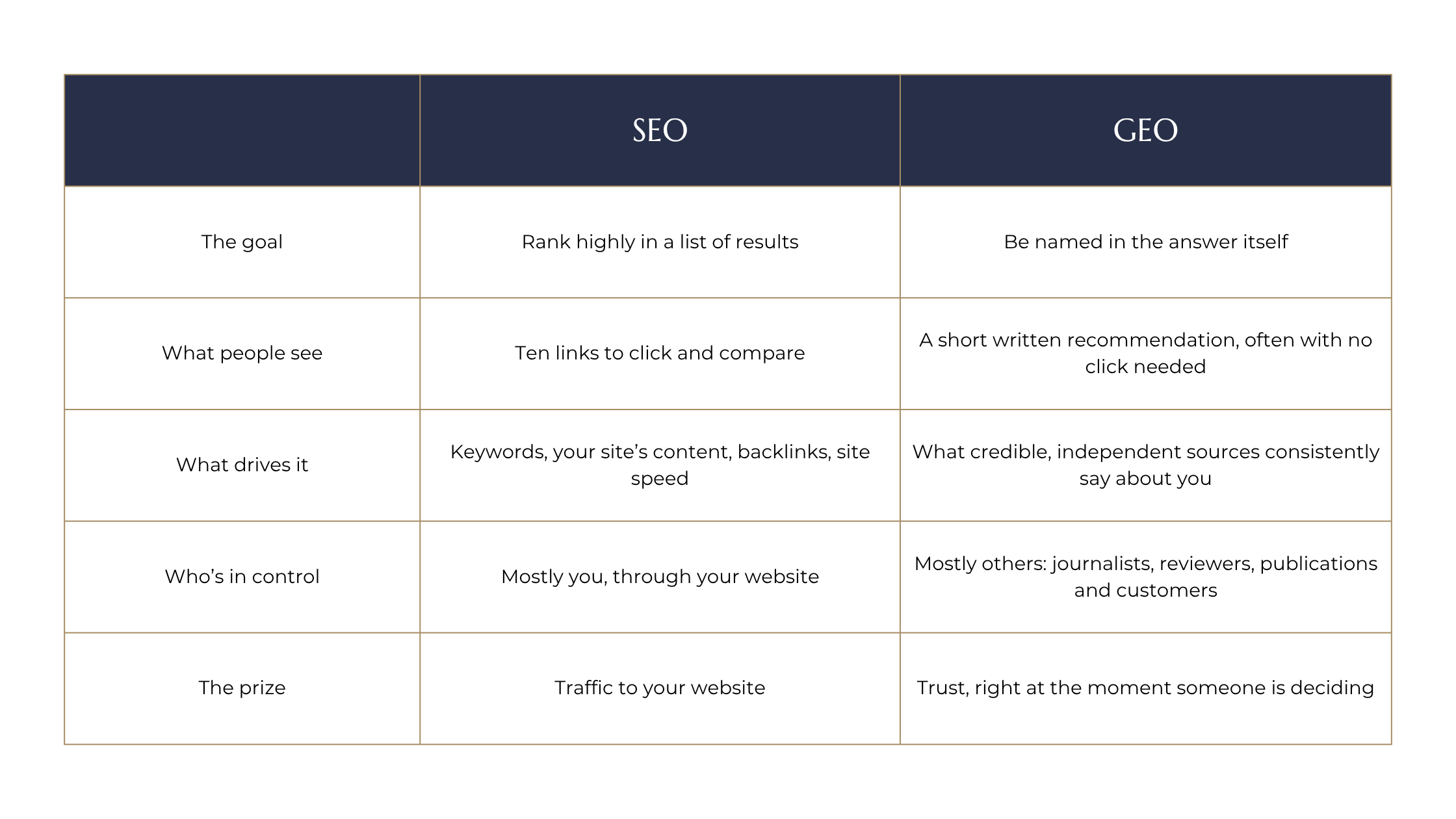
SEO helps your website rank on Google. GEO helps your brand get recommended by AI. There’s overlap, but they reward different things.
The row that matters most is who’s in control. With SEO, much of the work happens on your own website. With GEO, your website still counts (AI tools need to read it and get your facts right), but it’s only part of the story. What other people say about you tends to carry far more weight.
Why AI listens to what others say about you
AI tools build their view of a brand in two ways.
What they learned in training. Before a model is released, it reads a huge amount of public writing: news sites, magazines, reviews, forums and blogs. If your brand came up often in respected places, the AI already has a picture of you. If it rarely did, you’re starting from behind.
What they find when they search. When an AI looks something up live, it reads a small number of sources and leans on the ones that look credible and independent. A feature in a respected travel or boating magazine counts for a lot more than your own About page.
Think of it like asking a well-read friend for a recommendation. They’ll name the brands they keep reading about in places they trust. It’s why we see brands with beautiful websites and glowing testimonials missing from AI answers entirely. There just isn’t enough independent evidence out there for the AI to recommend them with confidence.
Why PR matters more than ever
The things AI tools trust most are the things good PR has always delivered. Earned media is independent and credible, and it’s written by journalists whose job is to tell the genuinely great from the merely well-marketed. Every feature, interview, review and expert quote is another piece of evidence an AI can find and cite.
That changes the value of a story. A feature isn’t just for the people who read the magazine that month. It keeps working for years, shaping how AI tools describe your brand to everyone who asks.
What brands can do now
Earn coverage where your audience already reads. Specialist travel, sailing and lifestyle titles carry real weight because they’re specific, credible and independent.
Tell the same story, consistently. AI picks up patterns. When respected sources describe you the same way again and again, that’s the description that sticks.
Keep your facts straight everywhere. Your name, what you offer, where you operate and your price point should match across your website, Google listing, booking platforms and press materials. Mixed signals make AI less confident about you.
Make your website easy to understand. Clear pages that answer the questions travelers actually ask (who it’s for, what’s included, how it works) help AI describe you accurately.
Ask for genuine reviews. A personal note to a happy guest asking for an honest Google review adds real third-party proof.
Show up as an expert. Quotes and commentary in the media position your team as the go-to voice in your niche, which is a big part of how AI decides who to recommend.
Where to from here
How people find travel, adventure and lifestyle brands is changing fast. What earns their trust hasn’t. It still comes down to good stories, told by credible people, in the places travelers already go for ideas.
That’s always been our work at Roam Generation. We live the lifestyle we represent, and our relationships with travel, adventure and lifestyle media help our clients earn coverage that both people and AI tools trust. We’re now also helping brands see how visible they are in AI answers, and what it’ll take to be the name that comes up when it counts.
Curious what ChatGPT says about your brand? Get in touch and we’ll run a quick AI visibility check for you.
shows up when travelers ask AI? Get in touch and let's find out together.
By Erin Carey
Erin Carey is the Founder and Director of Roam Generation, a boutique PR agency specialising in travel, adventure and lifestyle brands. She works with experiential companies across the US, UK and Australia to build authority through strategic earned media and thought leadership.
Roam Generation’s clients have been featured in publications including Travel + Leisure, Condé Nast Traveler, Forbes and National Geographic. In an era increasingly shaped by AI-driven search, Erin focuses on ensuring brands are not only visible, but trusted and cited where modern discovery happens.