
Why Global Travel Brands Need Different Stories for Different Markets
Many travel brands come to us with the same ambition: they want coverage in the US, the UK, and Australia. They want global recognition, stronger authority, and an audience that spans continents.
And somewhere along the way, someone suggests that the same story should work everywhere.
It rarely does.
A story that earns genuine interest from a journalist in New York may land flat in London. A pitch that resonates with Australian media may feel overcooked to a British editor. The brand hasn't changed. But the room you're walking into has, and if you haven't adjusted how you're showing up in it, you'll feel it in your results.
At Roam Generation, global PR is all we do. Our team members are based in the markets we work in, actively pitching, meeting with journalists, and building the kinds of relationships that take years to develop. Between us, we've visited 30 to 60-plus countries each. We've lived abroad, learned to navigate different cultures, and built friendships across every continent. Last month I was at a conference in Spain and got talking to a National Geographic journalist from the UK. She was genuinely interested in hearing about our clients operating on this side of the pond. That's not luck. That's what it looks like when you're genuinely embedded in the industry you represent.
We work with clients in Italy, Nicaragua, Switzerland, Norway, Australia, the US, Argentina, Vietnam, and Bali. Cultural fluency isn't a talking point for us. It's a daily practice.
Global Visibility Doesn't Mean One Global Story
The assumption that a single narrative can travel unchanged across international markets is understandable. It's efficient. It's tidy. It's also consistently wrong.
Journalists are not evaluating your story in isolation. They're evaluating it through the lens of their audience: their readers, their editorial priorities, the conversations already happening in their market. What feels bold and aspirational in one place can feel tone-deaf or overreaching in another.
The goal is never to change who a brand is. The goal is to make what they do feel relevant, locally and specifically, in a way that fits naturally into each market's conversation.
A Real Example: Matt Rutherford and the Arctic
We're currently working with Matt Rutherford, an American explorer and founder of the nonprofit Ocean Research Project, who is attempting the first-ever solo, unassisted, nonstop circumnavigation of the Arctic Ocean. More than 10,000 miles through some of the most hostile ocean environments on Earth. He holds two Guinness World Records. His 2011 solo circumnavigation of the Americas was documented in an Emmy-nominated PBS film. He's a TED speaker. The story, on its own, is extraordinary.
But "extraordinary" still needs to be framed differently depending on who's reading it.
We have team members in both the US and the UK working on Matt's campaign together. The strategy in each market looked noticeably different.
For the UK, the media materials were longer and more detailed. We created a full fact sheet to accompany the core story. There was significant thought given to credibility: how do you establish who Matt is, why this mission matters scientifically, what the research actually means? Photo credits were carefully checked. Every claim was substantiated. British media tends to respond to substance, and a healthy level of scepticism is built into how editors work. You don't lead with the drama. You earn the right to it.
Managing exclusives in the UK also required a different kind of care. We couldn't go out broadly all at once. A small number of journalists were approached at a time, with real consideration given to who gets what and when. Get that wrong and you lose the placement entirely.
The US approach operated on different terms. The headline does more work. The story leads. There's more appetite for bold positioning and a faster path to the human angle. In Matt's case, that means a man who grew up in a religious cult, spent his teenage years in and out of institutions, and found his way forward through sailing. That backstory lands in a particular way in a US media context.
Same man. Same voyage. Very different conversations.
What Each Market Actually Rewards
We've worked across enough markets to notice consistent patterns, though nothing is ever absolute.
The United States often responds to aspiration, scale, and transformation. Innovation matters. The personal narrative matters. There's generally more openness to bold positioning when it's backed by the right credentials.
The United Kingdom tends to reward substance, credibility, and genuine relevance. Promotional language creates resistance. Heritage, expertise, and cultural significance carry weight. If you can't back it up, don't say it.
Australia rewards authenticity above almost everything else. Journalists here have a good radar for anything that feels polished for the sake of it. Straightforward storytelling, genuine experiences, and practical relevance tend to outperform glossy narratives. It's also worth noting that Australian journalists can often offer confirmed assignments or guaranteed coverage for press trips in a way that US journalists typically cannot. That's a structural difference that changes how you approach them from the outset.
Cultural Nuance Is a Competitive Advantage
International PR success isn't about language. It's about understanding.
Different regions interpret stories through genuinely different lenses. Values, travel behaviours, media expectations, and editorial culture all shape how a pitch lands. The brands that consistently earn strong international coverage are the ones whose stories feel naturally part of global travel storytelling in each market, not imported into it.
That kind of fluency takes time to build. It comes from being in the room, attending the conferences, knowing the journalists by name, and understanding what they're currently working on and what they're tired of hearing. It's not something you can shortcut.
Effective localisation goes much deeper than surface-level adjustments. It means understanding audience psychology, regional travel trends, editorial priorities, and the specific cultural conversations already in motion. The strongest campaigns are built with flexibility from the beginning: narratives designed to adapt, not ones forced into a shape they don't naturally fit.
Why This Matters More in the Age of AI
As AI-driven search and discovery continue to evolve, relevance is becoming a harder currency. AI systems surface content that aligns with user intent, context, and demonstrated authority. Brands that have built genuine credibility across multiple markets through earned media create stronger signals of expertise across more contexts.
When storytelling in the age of AI is adapted effectively across regions, it contributes to a broader ecosystem of trust and discoverability. You're not just earning a placement. You're building a body of evidence that you know what you're talking about, for multiple audiences, across multiple markets.
Global authority is built locally. And in an AI-driven discovery environment, that distinction matters more than ever.
The Bottom Line
The most successful global travel brands understand that international visibility isn't achieved through repetition. It's achieved through relevance.
A story that works in the United States may need a different emphasis in the United Kingdom. A narrative that resonates in Australia may require different framing elsewhere. The brand stays consistent. The storytelling adapts.
At Roam Generation, we're led by two Australian women who genuinely love this industry and genuinely love the people in it. We travel to the conferences. We build the relationships. We have people on the ground in the markets where our clients need to be heard. We're a global company, structured to operate remotely, but our systems are solid, our practices are consistent, and we deliver the same level of dedication to every client, even when the path to results looks a little different in each country.
Because global PR isn't about telling the same story everywhere.
It's about telling the right story in the right place, and knowing the difference.
By Erin Carey
Erin Carey is the Founder and Director of Roam Generation, a boutique PR agency specialising in travel, adventure and lifestyle brands. She works with experiential companies across the US, UK and Australia to build authority through strategic earned media and thought leadership.
Roam Generation’s clients have been featured in publications including Travel + Leisure, Condé Nast Traveler, Forbes and National Geographic. In an era increasingly shaped by AI-driven search, Erin focuses on ensuring brands are not only visible, but trusted and cited where modern discovery happens.
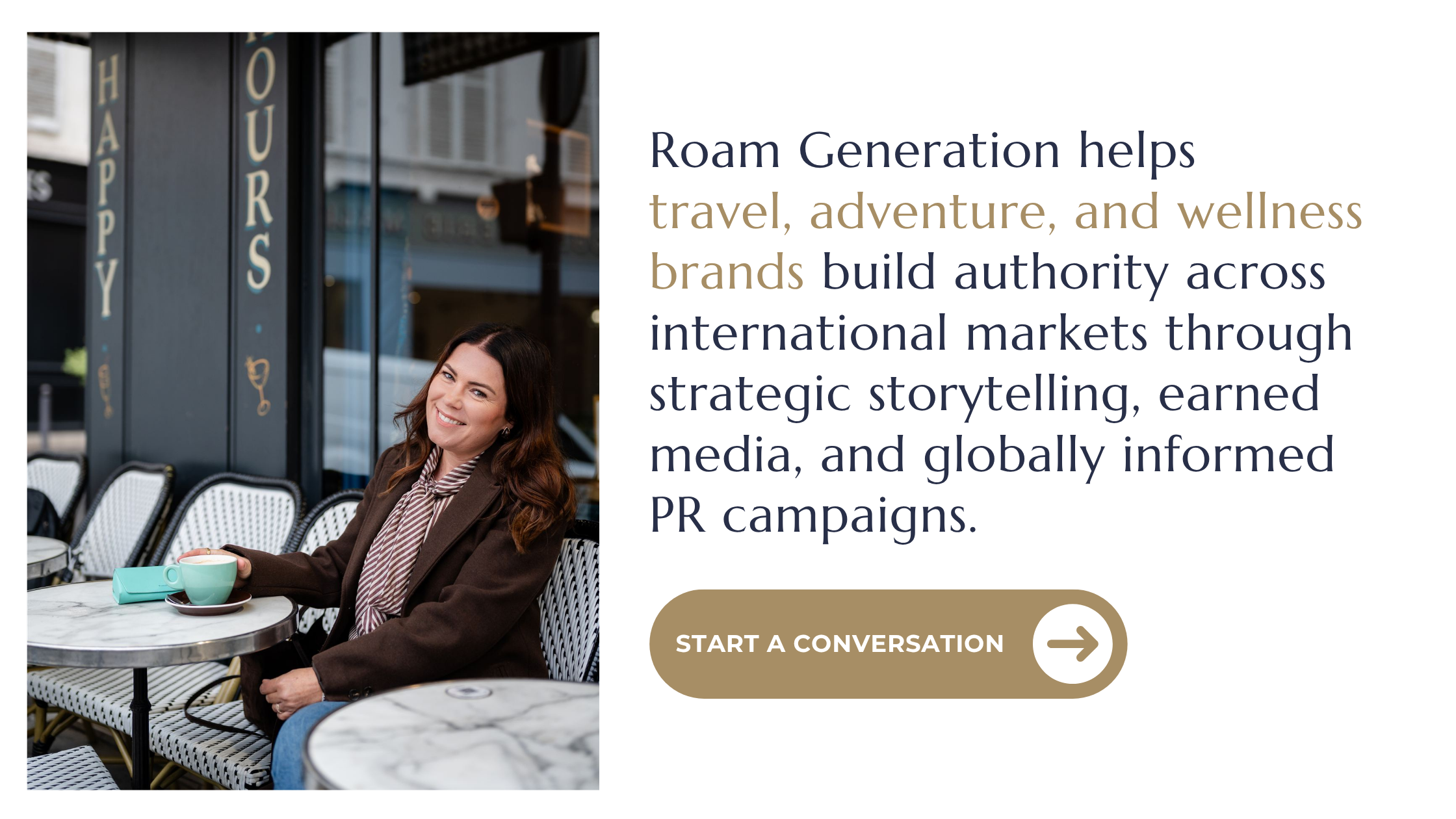
Roam Generation is a boutique global PR agency specialising in travel, luxury, adventure, yachting, and hospitality. Learn more about building travel brand authority across international markets.
